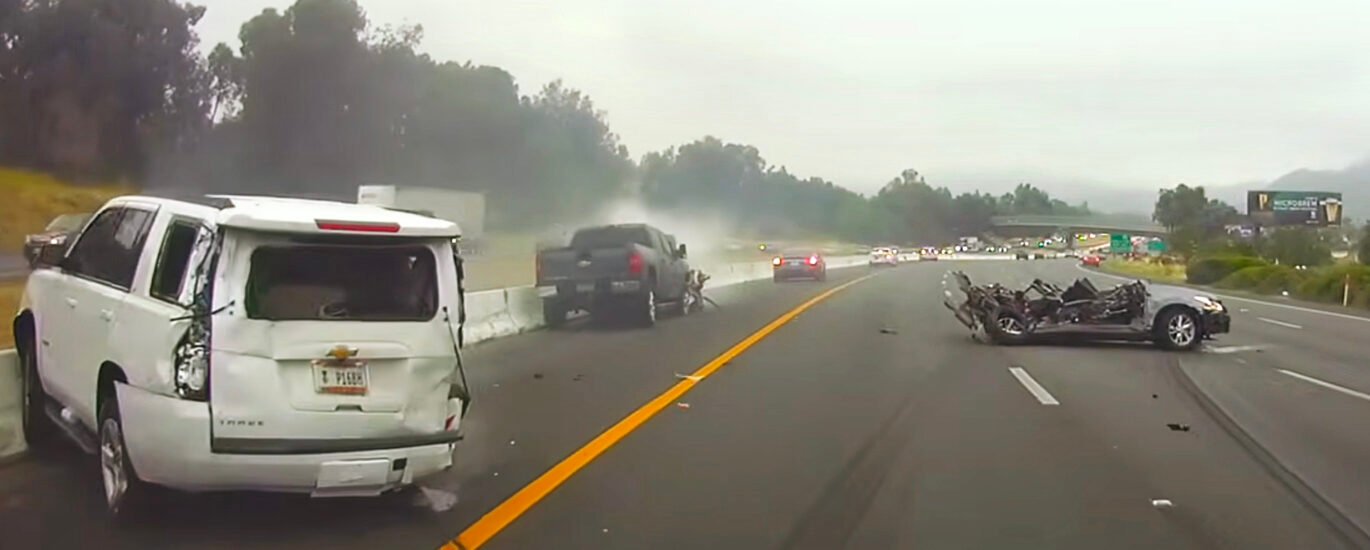
Drugged driving is a national crisis. Officials do little to stop it
Desperate to get a pulse, deputies pumped Madden Ohlwiler’s tiny chest.
“Please tell me, is my son OK? Is my husband OK?” cried Madden’s mother, Hayley.
Seconds earlier, she and her husband, Kyle, had been walking Madden in his stroller through their Orange County neighborhood. They heard a rumbling noise and turned to see a sedan veer off the street at 50 mph, jump the curb and careen toward them on the sidewalk.
The force of the crash flung the couple and the stroller into the air. Witnesses found Hayley on the sidewalk, her pelvis fractured in three places. Her husband lay face down nearby, shards of windshield glass lodged in his neck.
As panicked bystanders ran to help, the driver of the silver Hyundai Sonata slumped in the driver’s seat, snoring. Daniel Lenihan, then 54, was “cool, pale, moist, altered and looked completely out of it,” a paramedic reported.
He was also loaded with cocaine.
Madden was a smiley boy with fluffy blond hair, deep blue eyes and a chin dimple that resembled a Life Saver. He died from catastrophic injuries, including a severed spinal cord and fractures stretching around his skull. It was April 2, 2023 — five days before his first birthday.
“Why not me?” Hayley recalls pleading at the hospital later as she cradled Madden’s lifeless body wrapped in a blood-splattered blanket.
A nation that once threw an arsenal of laws and messaging at the scourge of drunken driving has allowed a kindred epidemic to emerge.
In recent years, an average of 30 people a day in the U.S. have been killed in vehicle crashes involving drugs including methamphetamines, cocaine, painkillers and marijuana — meaning at least one driver tested positive for drugs other than alcohol. Yet local, state and federal officials are failing at the most basic levels to confront the carnage, a Chronicle investigation found.
Thousands of pages of court records and police reports, body- and dash-camera videos, and interviews with nearly 100 people impacted by drugged-driving crashes, provide an expansive look at the circumstances surrounding fatal drug-related crashes that have occurred with little notice in every part of the country.
Public awareness is often limited to celebrity scandal, as when Tiger Woods, driving near his Florida home in March, rolled his SUV after clipping a truck. Authorities said the golf superstar admitted to taking pills and had painkillers in his pocket, though he ultimately pleaded no contest to reckless driving. A less discussed tragedy struck the next day in Napa County, when a man allegedly high on meth caused a head-on crash that killed three women.
At the core of the crisis: Authorities aren’t measuring the full death toll. The National Highway Traffic Safety Administration acknowledged more than a decade ago that it did not track all of these fatalities — and it still doesn’t.
Scientific and technological limitations have frustrated progress on developing reliable roadside tests for drug impairment. Even the rollout of drug screening devices has been slow and inconsistent.
In this environment, the work of patrol officers is essential. Yet the majority of law enforcement officers across the U.S. do not undergo advanced training to recognize drug impairment when they stop drivers. Whether drivers are drug-tested — even after fatal wrecks — depends on a patchwork of rules and judgments by local officers, state legislators and toxicology labs.
Most drivers who are killed or seriously injured in crashes aren’t drug-tested at all. Therefore, the nationwide count of drugged driving fatalities doesn’t include them.
In toxicology labs, there is little uniformity of drug testing. In 2007, a division of the National Safety Council put forward a list of drugs that labs should test for, but almost two decades later, labs do not consistently test for all of them.
These breakdowns are happening amid the proliferation of prescription drug abuse, the rise of new and potent synthetic drugs — such as the supremely powerful opioid painkiller fentanyl — and the legalization of cannabis. More Americans say they use marijuana on a daily basis than drink alcohol. Separately, a federal government survey estimated 2.1 million people drove after using cocaine, heroin, hallucinogens, inhalants or methamphetamine in 2024.
NHTSA’s most recent national roadside survey documented significant increases in drivers testing positive for drugs, but that was from more than a decade ago — before many states legalized marijuana. The agency’s roadside data collection has languished for several years. Meanwhile, a transportation bill that includes $100 million to combat drugged driving is stalled in Congress.
Law enforcement and public health officials have for years called for a stronger and more coordinated campaign against drugged driving. More than 15 years ago, the Obama administration said combating drug-impaired driving was a national priority. Soon after, a federally funded report described efforts to save lives as “grossly inadequate” and called for better data on crashes, consistent testing in investigations, and more research on everything from drug impairment to deterrence laws and enforcement.
In 2022, the National Transportation Safety Board, a federal agency that investigates major collisions and identifies needed safety measures, called on federal agencies to strengthen tracking of drug-related crashes and states to enact tougher rules on drug use and driving, and improve police enforcement. The agency argued its recommendations could “prevent accidents and save lives.” Yet lawmakers and regulators have not meaningfully advanced many of those reforms.
For example, the board asked NHTSA to establish common guidelines for drug toxicology screening of drivers after crashes or DUI arrests. NHTSA then shared standards on the scope of testing and drug detection cutoffs, but it can’t force states to adopt them.
The NTSB urged the U.S. Food and Drug Administration to conduct a study on prescription and over-the-counter drug labeling to see if there’s a better way to make consumers aware of driving risks. The FDA has failed to publish any such studies. FDA officials did not respond to a request for comment.
“This is a silent epidemic, people are dying, but it’s still being swept under the rug,” said Andrew Yockey, an assistant professor of health and kinesiology at the University of Illinois Urbana-Champaign who focuses on mental health and substance use epidemiology. “We’ve not seen national enforcement yet. Federal agencies and Congress could have treated this 15 to 20 years ago.”
In response to questions from the Chronicle, NHTSA disputed that it had faltered in any way. “Any claim that NHTSA is ignoring recommendations or moving too slowly on drug-impaired driving is false.”
To the extent that anti-drugged-driving efforts have stalled, NHTSA said it lacks the authority to compel improvements on the ground. NHTSA “cannot mandate state traffic laws or how local labs test for drugs,” the agency’s statement said, adding that it “works directly with states to strengthen local testing capabilities, improve national crash reporting, and support oral fluid testing initiatives as the underlying science advances.”
From 2014 through 2024, more than 420,000 people were killed in vehicle accidents in the U.S. The Chronicle’s analysis found that more than a quarter of these deaths — nearly 110,000 — occurred in wrecks in which at least one driver tested positive for drugs.
The U.S. tracks fatal vehicle crashes in the Fatality Analysis Reporting System, a national database managed by NHTSA that helps lawmakers, safety advocates and others shape legislation and inform life-saving policies. But in 2023, almost two-thirds of drivers involved in fatal crashes did not have a drug test recorded in the FARS database. The number of drivers killed in crashes with a reported drug test ranged from 8% in North Carolina to 71% in California to 96% in Massachusetts.
For most of its history, the FARS database only let agencies report three drugs per driver, arbitrarily leaving out other confirmed substances that may have been critical factors in crashes. NHTSA removed the reporting restriction in 2018, acknowledging it had undermined the data’s accuracy.
Making matters worse, limited resources and staffing at toxicology labs mean it can take up to six months for labs in some parts of the country to produce toxicology results. The lag means that some data doesn’t make it into the agency’s yearly release.
The lackluster effort against drugged driving to date stems in part from the absence of a well-understood legal red line like the .08 blood-alcohol level that 49 states use to measure drunken driving. The prevalence of these crashes, meanwhile, traces to common beliefs that, in contrast to alcohol, some drugs don’t impair driving.
Abuse of prescription drugs has been classified as an epidemic by the Centers for Disease Control and Prevention, but many people assume they’re safer than street drugs like meth. In a 2025 national survey of licensed drivers, about 30% disagreed that driving within an hour of using marijuana was very or extremely dangerous, according to a AAA report.
“They are misunderstanding what the research is telling them,” said Ed Wood, who founded DUID Victim Voices, a research and advocacy organization committed to reducing drugged driving, after his son was killed in Washington state in 2010 by two women driving an SUV with multiple drugs in their systems. “The bottom line is it’s very dangerous to have any kind of drugs on board.”
After the tragic sidewalk crash in Orange County’s Las Flores neighborhood, Lenihan was charged in September 2023 with committing vehicular manslaughter with gross negligence while intoxicated, along with driving under the influence of drugs and causing injury.
Justice was slow and, in Kyle and Hayley Ohlwiler’s view, far too lenient. It took several months for the toxicology results to come in, and the court case dragged on for three years. Finally, this past May, a judge sentenced Lenihan to 12 years and eight months in state prison. He is likely to serve half of that.
The couple filed a wrongful death lawsuit against Lenihan that was settled in December 2025.
“This is wrong,” said Hayley Ohlwiler. “No amount of time served will bring our son back. But we wanted a consequence that befits the crime. He got next to nothing for a sentence. It feels like the state of California is saying you can go and kill someone and then get a few years and get out. It feels like such a breach of true justice for us and for other victims’ families. These cases will just keep happening.”
Law enforcement in the U.S. has primarily combated driving under the influence of alcohol through traffic stops and patrols on roadways.
The vast majority of police academies have made training on the standardized field sobriety test mandatory. Officers generally use three roadside tests — the one-leg stand, the walk-and-turn and observing drivers’ eyes for involuntary jerking — to identify drivers suspected of being under the influence of alcohol.
But even as drugged driving crashes and deaths have mounted, local law enforcement agencies haven’t risen to the challenge with more training. In fact, the number of officers specially trained to evaluate whether drivers are high slid in recent years.
Drunk driving prosecutions can rely heavily on blood-alcohol content results. Without a definitive test for drug impairment, it instead largely falls to officers to identify evidence of impairment in criminal cases. But in case after case reviewed by the Chronicle, officers overlooked motorists who showed signs of impairment — drivers who later caused crashes and tested positive for drugs.
“Drivers may face different outcomes depending on where they’re stopped, when they’re stopped and why they’re stopped,” said Yockey, the University of Illinois assistant professor. “Many drivers who are impaired are not even identified if they’re stopped. When decisions rely on officers’ subjective observations rather than standardized measures, it increases the risk of disparities, undermines public trust and puts lives at risk.”
The issue dates back years. More than a decade ago, a U.S. Government Accountability Office report relying on interviews with prosecutors and safety officials found that police officers had little to no knowledge of how to spot drivers who were dangerously high.
In one example, a prosecutor told federal researchers that some untrained officers believe “that a drug-impaired driver should exhibit similar symptoms as a drunken one, including slurred speech and difficulty maintaining balance.” Those officers were said to be more likely to miss evidence that drivers were impaired from marijuana, prescribed narcotics or street drugs.
Today, most jurisdictions do not provide officers with advanced instruction on how to spot drug impairment. More intensive training to detect drugs is decided agency by agency. A two-day course, the Advanced Roadside Impaired Driving Enforcement program, is a wake-up call of sorts for officers because it trains them to look for intoxication from drugs other than alcohol.
“Officers will pull the person over,” said Ryan Smith, who oversees national traffic safety research for Responsibility.org and the National Alliance to Stop Impaired Driving. “They won’t smell alcohol. They may assume the person is not impaired when the person doesn’t blow a high BAC (blood alcohol concentration). The danger is they’re not thinking about the drugs that the driver could be on.”
The most advanced training is the Drug Recognition Expert program, which dates back to the 1970s, when the Los Angeles Police Department created a course. Considered the most effective way to detect drug-impaired drivers, it requires officers to follow a 12-step evaluation protocol. The course is intense, with 72 hours of classroom instruction and about 40 to 60 hours of field work, and requires departments to take officers off the street while they learn how to recognize not only drug impairment, but also different classes of drugs.
As of last year, just over 8,600 officers, or about 1% of all law enforcement officers, were certified as drug recognition experts, down from nearly 9,900 in 2019. Agencies nationwide tend to send high-performing officers to DRE training. But these officers are often promoted or change duties and let their certification lapse.
DREs can play a central role in fatal crashes, where cases often come down to a battle of experts, prosecutors say. When officers do a field sobriety test and conclude a driver is impaired by a substance other than alcohol alone, they can call in a DRE to do an evaluation at a police station. These officers collect more than 100 data points such as a driver’s pulse, blood pressure, body temperature, injection marks and powder in the nose.
Officers can use this evidence to make an arrest, or after an arrest, to determine which of the seven drug categories suspects used — narcotic analgesics, hallucinogens, cannabinoids, disassociative anesthetics, inhalants, central nervous system depressants and stimulants. It also strengthens prosecutions; district attorneys can call DREs as expert witnesses.
“We’ve been begging them to get more DREs for fatal (crashes),” said Steven Ueltzen, a senior deputy DA with the Fresno County District Attorney’s Office. “They know their stuff and are well-equipped to answer questions at trial.”
Caroline Cash, a spokesperson for the Governors Highway Safety Association, said that standardized field sobriety test training should be mandatory in every U.S. law enforcement academy, and that more officers should be required to complete the ARIDE training within the first few years of graduating. Congress, she said, could fund more training, as could states by using fees collected from offenders.
“We’re behind,” Cash said. “If they want to remove drug-impaired drivers from their roads, it’s imperative that states and counties invest in training their officers.”
Officers who take specialized training often view their previous traffic stops in a new light.
“Officers will say, ‘I thought there was something wrong with so and so, and I let them go,” said Jerry Miller, director of the Institute for Traffic Safety Management and Research at the University at Albany, and the former state coordinator for New York’s DRE program. “It will dawn on them that, ‘Oh, I let someone go.’”
Thomas McGrath was let go.
On May 9, 2023, in upstate New York, motorists tailed the 71-year-old man for about 25 minutes as he weaved his black Mercedes into the oncoming traffic lane and blew through three red lights. They finally cornered him in a parking lot in the town of Colonie and held him until local officers arrived.
A Colonie officer, Frank Peris, later noted in a report that McGrath “did not have any indicators of alcohol or drugs.” Believing the issue was diabetes-related, Peris called in emergency responders who ultimately released him.
Two days later, McGrath rear-ended a vehicle. He told Colonie police that his foot had slipped off the brake. After the crash, witnesses reported that McGrath sat in his car “slumped over” and “dazed,” records show. McGrath told police he was tired due to the sun. Officers did not perform a sobriety test and permitted McGrath to keep driving, according to court records.
That afternoon, McGrath was roughly 8 miles away when he crossed a double yellow line on Route 85 and crashed into 17-year-old Michael Kleinke Jr. as he drove home from a doctor’s appointment. An ambulance rushed the teen to a hospital with major head trauma, broken bones and abdominal bleeding. He died two days later.
McGrath pleaded guilty to manslaughter and drugged driving, admitting he took Vicodin laced with fentanyl and drank beer before the crash.
Colonie police officials did not respond to the Chronicle’s questions about its evaluation of McGrath leading up to the fatal crash and whether its officers were trained to recognize drug impairment.
On its Facebook page, the department says that one of its “most important responsibilities is keep(ing) our roadways safe by removing intoxicated/impaired drivers from our local roads.”
Kleinke’s parents sued Colonie, alleging officers were negligent in failing to arrest McGrath before the crash. They later withdrew the suit because there was no direct contact between police and their son.
“The Colonie Police Department failed my son, wholeheartedly, in every aspect,” said Kleinke’s father, Michael. “That police department should be held accountable. Ultimately it was McGrath’s choice to drive under the influence. But in my eyes, this never should have happened.”
Law enforcement’s inability to consistently recognize drivers impaired by drugs has been compounded by a cascade of flaws in how authorities administer toxicology tests, undercutting prosecutions and making comprehensive tracking of the public health crisis impossible.
Drivers suspected of alcohol impairment can generally blow into a Breathalyzer device to produce a rapid measurement of alcohol in their system, or be arrested and taken for a blood draw or evidential breath test, usually at the station. However, there is no widely deployed device that officers can use to test for a broad array of drugs and measure drug impairment.
The country’s haphazard approach is perhaps best illustrated by the hit-or-miss use of oral-fluid drug testing, considered by many to be the best option available for police agencies in need of quick results. The devices generally have technology akin to a pregnancy test that uses an optical reader, but to identify the presence of drugs.
Oral-fluid tests are frequently compared to the portable breath test used by officers to detect alcohol. They test for the presence of drugs other than alcohol. While no roadside chemical test providing immediate results covers all drugs, a positive result can give an officer the confidence to call in a DRE to take the driver through an evaluation.
Fifty years ago, drunk driving enforcement was similarly plagued by disagreements over how to prove a driver was too impaired to safely operate a car. State laws varied widely. In 1983, lawmakers in Oregon and Utah made it illegal to drive with a blood-alcohol level of 0.08 or higher, then the most stringent criminal standards in the U.S.
Researchers, largely funded by federal transportation agencies, soon found drunken driving fatalities fell sharply in the two states, prompting California and several others to follow suit. Congress made 0.08 the legal limit nationwide in 2000, enacting legislation that required states to adopt it or lose part of their federal highway funding. (Utah has since lowered its blood alcohol limit to 0.05.)
Lawmakers and regulators have not pushed reforms or new funding for drugged driving with the same urgency. Policy experts say scientific limitations are partly to blame, as the field has been unable to conclusively define what counts as unsafe levels for specific drugs. Numerous federal agencies — including the NHTSA, the National Institutes of Health and the CDC — have funded research to try to figure out what toxicology results can prove about drivers’ focus and motor skills. However, those studies largely focused on alcohol, with drugs treated as a secondary concern.
“The science has held us back,” said Stephanie Manning, chief government affairs officer for Mothers Against Drunk Driving. “Legalization has taken off across the country, and we don’t have the systems in place to deal with this crisis. There’s just not enough funding devoted to traffic safety.”
Few police agencies use oral-fluid tests in part because of a gap in federal leadership. NHTSA has not provided law enforcement with a list of approved, reliable oral-fluid devices like the agency’s log of breath tests for alcohol.
Some states don’t authorize or empower officers to use oral-fluid collection. For example, in New York, drivers can consent to a roadside screening with oral-fluid swabs, but there is no consequence if they refuse because this method isn’t specifically mentioned in state statute.
Beyond submitting to oral-fluid testing, many drivers aren’t being tested for drugs at all — even after fatal crashes. When blood testing is done, labs typically only perform the bare minimum, at times opting not to check for the most common drugs, particularly when alcohol is detected.
When Daniel Luna crashed his SUV into a pickup truck on New Year’s Day in 2021 in Avenal (Kings County), killing the other driver and seven children as well as himself, the toxicology lab tested for alcohol and other drugs, but cannabis wasn’t included in the drug panel. It wasn’t until NTSB investigators asked the Federal Aviation Administration lab, the nation’s premier toxicology operation, to run a drug test, that they discovered both drivers tested positive for marijuana.
In this case, NTSB investigators could not determine to what degree cannabis contributed to the crash, and concluded that Luna’s alcohol impairment was the primary cause.
Nevertheless, the agency recommended that California standardize its toxicology testing practices to include all of the National Safety Council’s Tier 1 drugs, including cannabis.
“If you don’t collect the data, you don’t even know what you’re missing,” said Smith of Responsibility.org and the National Alliance to Stop Impaired Driving. “We have this tremendous safety blind spot.”
One fundamental problem is the variation in toxicology drug testing among American labs. Decisions on whether to test drivers involved in fatal crashes, which drugs to test for and what methods to use are often up to labs, state and local officials, and — in many places — individual police officers. Many crime labs test for just a few substances, with even common drugs such as cannabis excluded.
The disparities in which drugs are tested for, and at what levels, date back years: A 2011 report prepared for the National Institute on Drug Abuse, which funds and conducts addiction research, said toxicology lab testing systems “evolved independent of any national guidance. The legacy is a patchwork of inconsistent practices.”
Current recommendations include that labs testing for drugs impose uniform cutoffs — the amount of a drug that defines a “positive” result — and ensure they are testing for 35 “Tier 1” drugs, which often appear in impaired driving arrests, in all fatal crash investigations. The National Safety Council’s Alcohol, Drugs and Impairment Division found that just 16% of labs that responded to a survey had fully met the guidelines.
Complicating matters, many areas in the U.S. including Washington, Wisconsin and Montana use stop-limit testing, in which labs won’t test for drugs if alcohol is detected at a certain level. About half of the labs that responded to a recent survey by the same organization reported using stop-limit testing. Every time the lab has to run an additional test, it costs money — and some agencies argue they lack the personnel, technology or facilities to check drivers for an array of substances in every case.
In 2022, the NTSB asked states to eliminate stop-testing policies and always test for at least a baseline panel of drugs, regardless of a driver’s blood alcohol content. Most have not acted.
Many laboratories in California still use stop-testing, and there isn’t a minimum statewide standard for testing for drug-related crashes. Not only do many of the 20 toxicology labs across the state lack the staff or funding to test all samples for drugs, but some law enforcement officials consider traffic enforcement a lower priority.
Two of the largest toxicology lab systems in the state, overseen by Los Angeles County and the California Department of Justice, are not getting complete data, because they don’t test for drugs if specimens are positive for alcohol. Labs in San Francisco, Sacramento and Orange counties test for hundreds of substances, but the toxicology lab in Los Angeles County tests for a fraction of that.
“The unfortunate part about that is that drivers get sentenced to rehab for alcohol, but they’re actually drug users so they don’t get the treatment they need,” said Candace Lightner, founder of We Save Lives, an advocacy organization that has pushed for drug testing of all drivers and passengers.
Things could be different.
In the U.S., there is essentially a zero tolerance policy for commercial drivers nationwide, meaning they can’t use cocaine or other illicit drugs and drive.
There are other potential solutions, according to experts. Yockey said Congress should improve national data collection with a public-facing dashboard, integrating drugged-driving fatalities, arrests, prosecutions and toxicology results, and fund more impairment research, particularly in certain areas.
“What are the effects of driving under the influence of cannabis, prescription drugs and polysubstance use?” he asked. “Research generally indicates that cannabis and several psychoactive prescription medications can impair driving and may increase crash risk, but estimates vary substantially across substances and studies.”
Adopting national standards for drug impairment, similar to the 0.08 BAC for alcohol, would require scientific and technological advancements, experts say. An NHTSA spokesperson told the Chronicle that the agency “cannot recommend an impairment standard or per se level for drugs other than alcohol, as this would not be scientifically sound.”
Earlier this year, NHTSA did launch a campaign against traffic deaths, including those tied to drugged driving, an iteration of the agency’s past efforts to reduce traffic fatalities.
The agency said the initiative, Pathways to Safer Streets, “is prioritizing the support of state efforts to combat drug-impaired driving, including law enforcement, toxicology, prosecution, licensure, and probation. While NHTSA cannot mandate state traffic laws or how local labs test for drugs, the agency actively equips state partners with the funding, training, and technical resources needed to tackle this challenge.”
It’s not clear, however, whether states will use federal funding and resources in a way that curbs drugged driving. A training gap remains among prosecutors, judges, law enforcement and legislators related to drugs beyond alcohol. In addition, the NHTSA initiative doesn’t provide a minimum standard for drug testing or advance national regulations for oral-fluid testing, for example, though the agency says these would require Congressional action.
In 2018, NHTSA declared drug-impaired driving a “top priority” and launched a new initiative, including a summit where elected officials and others discussed how to collect consistent data, test and measure drivers’ impairment, and enforce drugged driving laws. Heidi King, then the agency’s deputy administrator, said at the time, “We cannot afford to wait.”
While NHTSA’s effort to combat drugged driving involves multiple offices, the number of employees in the agency’s Impaired Driving Division has dwindled. At the start of 2025, it had eight workers. But the fear of DOGE cuts and attrition decimated its ranks. It now has a staff of three.
Credits
Reporting by Jennifer Gollan. Data analysis by Sriharsha Devulapalli. Photos by Gabrielle Lurie, Dania Maxwell and Lynsey Weatherspoon. Editing by Ryan Gabrielson and Demian Bulwa. Data editing by Dan Kopf. Photo editing by Emily Jan. Video editing by Joy Jeong and Wendi Jonassen. Design and development by Daymond Gascon. Design and development editing by Erin Caughey and Alex K. Fong. Audience by Jess Shaw.
Originally published on Oct. 28, 2026
